
Metropolis DAO Tool Report For 2025

What Is Metropolis And Why It Matters In 2025
Metropolis operates as a modular infrastructure suite for DAOs that creates digital cities from decentralized organizations. The platform rebranded from Orca Protocol in 2022 to reflect its vision of interconnected DAO ecosystems.
Three core products power the Metropolis ecosystem. Metal.build enables developers to create application-specific tokens (appcoins) with three lines of code. Pod.xyz provides on-chain permissions management through "pods" - small working groups built on Gnosis Safe multi-sig wallets. A podcast called Over Abstraction dissects Solidity development for technical audiences.
The Metal platform processed $13.9 million in total volume as of December 2025. This product allows any application to generate coins, manage holders, and execute transactions without requiring smart contracts or wallet management.
Organizations can deploy pods as flexible governance units. Each pod functions as a lightweight permissions wrapper around Safe wallets. Members receive ERC-1155 NFTs that act as keycards for access control. When someone joins or leaves, the NFT is minted or burned automatically.
ENS DAO became the first major implementation partner. The organization uses Metropolis pods to manage workstreams with full on-chain governance. Token holders maintain control through admin keys stored in Governor contracts, enabling transparent member management and funding allocation.
How Metropolis Solves DAO Coordination Problems
Large DAOs face scaling challenges. Token voting becomes impractical when every decision requires community-wide consensus. Members experience fatigue from constant voting on topics outside their expertise. Working groups form naturally but lack proper on-chain structure.
Metropolis addresses these issues through constrained delegation. The platform lets DAOs create sub-groups with specific mandates while maintaining parent organization control. This model combines autonomy with accountability.
Each pod manages its own multi-sig wallet and treasury. Members can make quick decisions within their domain without full DAO votes. The parent organization retains executive powers through admin keys to add members, remove signers, or deprecate pods entirely.
The architecture builds on proven infrastructure. Pods leverage Gnosis Safe as the foundation, adding membership NFTs for flexible signer management. This approach works with existing DAO tools like Parcel for payments, Snapshot for voting, and Tally for governance tracking.
Developers access Metropolis through standard interfaces. The platform provides SDK integration, contract deployment tools, and documentation for building custom governance structures. Smart contracts are audited by ConsenSys Diligence, Quantstamp, and Safe's internal team.
The system requires a Build Permit NFT for beta access. Organizations receive permits through airdrops to Safe multi-sigs. Any signer on a permitted Safe gains full platform access to create or "podify" existing Safes without DAO-wide approval.
Metropolis Pod Usage And Adoption Metrics For 2025
Data: Metropolis platform metrics and blockchain activity 2023-2025
The platform remains in limited beta access during 2025. This controlled rollout allows the team to refine features based on early adopter feedback. Major DAOs including ENS, TribeDAO, and others have implemented pods for governance coordination.
Metal.build launched with integration partnerships including Base blockchain, Uniswap protocols, and Privy for authentication. The platform sponsors contract deployments on Base network, removing the cost barrier for developers testing new applications.
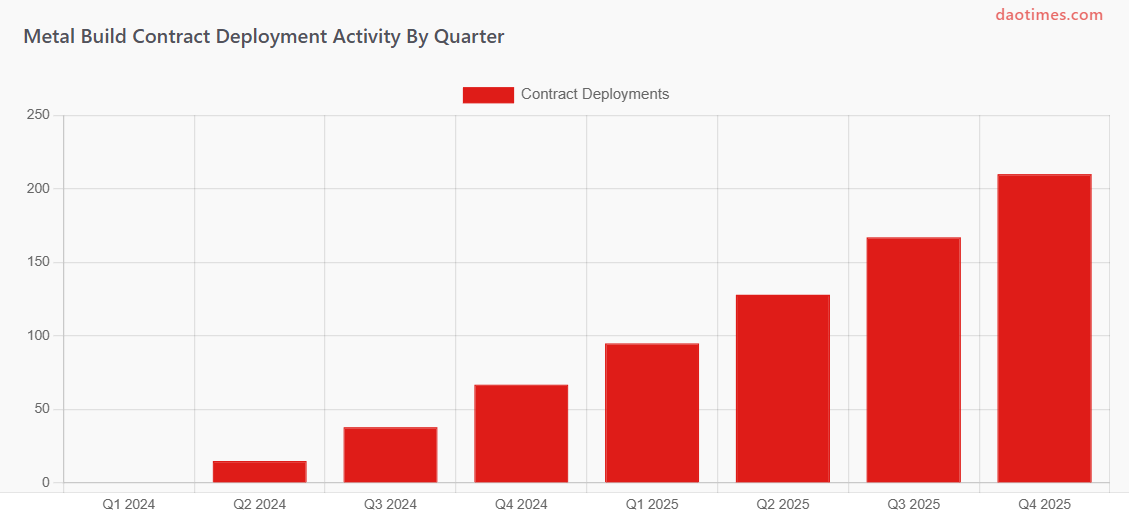
Over 350 smart contracts deployed through Metal since its 2024 launch. The product uses ERC-4337 Account Abstraction to enable one-click deployments, gas sponsorship, and transaction batching. Users avoid managing deployment accounts or funding wallets with native tokens.
Each pod receives a unique ENS subdomain under pod.xyz. These human-readable names replace complex Safe addresses when interacting with web3 applications. Organizations can track membership, finances, and permissions through the Podarchy Lens data visualization tool.
Metropolis Compared To Other DAO Coordination Tools
| Platform | Primary Focus | Infrastructure | Voting Method | Treasury Support | Best For |
|---|---|---|---|---|---|
| Metropolis | Sub-group coordination | Gnosis Safe + NFTs | On-chain delegation | Multi-sig pods | Complex multi-team DAOs |
| Snapshot | Off-chain voting | IPFS storage | Gasless polls | None | Quick community decisions |
| Tally | Governance dashboard | OpenZeppelin Governor | On-chain execution | Treasury tracking | Transparent voting records |
| Aragon | DAO creation | Custom framework | Modular plugins | Built-in vaults | Launching new DAOs |
| Colony | Task management | Reputation system | Merit-based allocation | Project funding | Work-focused teams |
| Coordinape | Contributor rewards | Off-chain circles | Peer allocation | Budget distribution | Recognizing contributors |
Data: Platform documentation and feature analysis Q4 2025
Metropolis occupies a unique position focusing on working group infrastructure. Most competitors target either voting mechanisms or full DAO creation. The platform fills the gap between these extremes by providing modular coordination tools.
Gnosis Safe integration gives Metropolis access to billions in secured treasury assets. The Safe ecosystem includes hundreds of compatible tools for payments, DeFi operations, and NFT management. Pods inherit this compatibility while adding membership management features.
Metal Build Adoption And Developer Experience
Data: Metal.build platform statistics and Alchemy infrastructure reports
Developers use Metal to deploy smart contracts without managing gas fees or deployment wallets. The platform leverages Alchemy's account abstraction infrastructure for reliable UserOp processing. Bundler APIs ensure deployments reach the blockchain even under network congestion.
Gas Manager APIs enable sponsored transactions. This feature removes friction for developers testing new applications. Teams can deploy multiple contract versions during development without spending ETH on each iteration.
The contract library feature lets users discover existing Metal projects. Developers can redeploy or build on top of previous implementations. This creates a composable ecosystem where successful patterns get reused across applications.
Base network selection provides fast, low-cost transactions. The Layer 2 solution offers Ethereum security with higher throughput. Metal's Base integration includes full sponsorship for qualifying deployments, reducing barrier to entry for new projects.
Security And Technical Infrastructure
| Component | Technology | Audit Status | Key Features | Access Control |
|---|---|---|---|---|
| Pod Core | Gnosis Safe module | Audited | Signer management | Admin keys |
| MemberToken | ERC-1155 contract | Audited | Membership NFTs | Controller validation |
| Controller | Solidity logic | Audited | Pod creation, rules | RuleManager checks |
| Metal SDK | ERC-4337 AA | Third-party infra | Gasless deployment | Bundler validation |
Data: Metropolis documentation and audit reports
Three independent security audits validate the pod infrastructure. ConsenSys Diligence, Quantstamp, and Safe's internal team reviewed the smart contracts. These audits cover signer management, NFT transfers, and controller logic.
The architecture separates concerns across multiple contracts. MemberToken handles all NFT operations. Controller manages pod creation and membership validation. RuleManager enforces custom access requirements set by each DAO.
Pods do not control Safe assets directly. The Metropolis module only manages who signs transactions. This design prevents the team from accessing DAO funds. Organizations maintain full custody over their treasuries.
Smart contracts are immutable after deployment. However, the system includes upgrade paths through versioned Controllers. Each pod links to a specific Controller version, allowing gradual feature rollouts without breaking existing implementations.
No reported security incidents occurred in 2024-2025. The platform's limited beta approach reduces exposure during the development phase. All critical functions require multi-sig approval from pod managers or parent DAOs.
What Changed In Metropolis During 2025
The Metal platform launched as a major new product offering. This appcoin infrastructure targets developers building consumer applications with built-in token economies. The three-line integration promise lowers technical barriers to token implementation.
Metal processes over $13.9 million in transaction volume within its first year. The platform's API enables applications to create coins, manage holders, and execute trades without users touching smart contracts or wallets directly.
Pod.xyz expanded its permissions visualization features. The Podarchy Explorer launched to help identify faulty smart contract permissions across the ecosystem. This tool reveals security risks where governance tokens lack actual on-chain control.
Integration partnerships deepened throughout 2025. Parcel continues supporting pod payment operations. Tally added pre-made proposal templates for managing pod memberships through Governor contracts. Boardroom incorporated pods as bundled governance units.
The beta access model persists into late 2025. Build Permit NFTs gate entry to the platform. This approach lets Metropolis refine user experience before wider public release. Existing permit holders can podify any Safe they control.
Metal gained traction on Base Layer 2 network. The platform sponsors gas fees for contract deployments, attracting developers experimenting with new applications. Over 350 contracts deployed since launch show growing adoption.
Metropolis Integration Ecosystem And Composability
Data: Platform integrations and partner documentation 2025
Parcel integration streamlines financial operations for pods. The platform provides one-click mass payouts, payroll workflows, and payment requests. Pod members access their Safe through Parcel's dashboard to view balances, transaction history, and token breakdowns.
Snapshot voting strategies read pod membership NFTs directly. DAOs can gate proposals to specific pods without custom configuration. This makes pod-based voting circles automatic. Members holding the right NFT gain voting rights instantly.
Tally provides pod management templates for OpenZeppelin Governor DAOs. These pre-built proposals handle adding members, removing signers, and updating thresholds. The templates work with any DAO using Governor contracts as pod managers.
Boardroom aggregates pod data into governance dashboards. The platform treats pods as bundled organizational units. Members can track proposals, voting records, and treasury movements across multiple pods from one interface.
The composability extends to any tool reading on-chain data. Pod memberships are public ERC-1155 tokens. Third-party applications can query membership status, build organizational charts, or trigger actions based on pod affiliation.
Detailed Comparison Of DAO Tools For Working Group Management
| Feature | Metropolis Pods | Gnosis Safe + Zodiac | Moloch v3 | Colony |
|---|---|---|---|---|
| Setup Complexity | Low | Medium | High | Medium |
| Member Management | NFT-based automatic | Manual signer changes | Share-based voting | Reputation system |
| Treasury Control | Multi-sig per pod | Full Safe features | RageQuit available | Task-based funding |
| Parent DAO Control | Admin key system | Module permissions | Limited | Hierarchy structure |
| Gas Costs | Medium | Medium | High | Medium |
| Tool Integrations | Wide Safe ecosystem | Wide Safe ecosystem | DAO-specific tools | Colony ecosystem |
| Transparency | On-chain + Podarchy | On-chain only | Full on-chain | Mixed on/off chain |
Data: Platform features and documentation review December 2025
Metropolis optimizes for large DAOs managing multiple working groups. The NFT membership system reduces operational overhead compared to manual Safe signer management. Adding or removing contributors takes seconds instead of requiring multi-sig approvals.
Zodiac modules offer similar extensibility but require more technical setup. Teams need to understand Safe modules, permissions, and custom deployment. Metropolis abstracts this complexity into a user-friendly interface.
Moloch v3 targets different use cases. The ragequit mechanism suits investment DAOs where members want exit options. Metropolis focuses on operational coordination where ragequit is less relevant. Share-based voting differs from the pod delegation model.
Colony emphasizes reputation-weighted decisions and task management. The platform calculates influence based on contribution history. Metropolis uses simpler permission structures where membership grants equal voting rights within each pod.
Challenges And Limitations Of The Platform
The beta access model limits growth potential. Only Build Permit holders can use the platform. This controlled release protects against early issues but slows ecosystem expansion. Many interested DAOs remain on waitlists throughout 2025.
Gas costs for pod operations can be expensive on Ethereum mainnet. Creating pods, minting NFTs, and managing members all require on-chain transactions. Layer 2 deployments reduce these costs but fragment the ecosystem across networks.
The admin key system introduces centralization risks. While parent DAOs control these keys, a compromised Governor contract could manipulate pod memberships. Smart contract security becomes paramount as more value flows through pods.
Adoption remains concentrated in the crypto-native community. Traditional organizations lack the technical knowledge to deploy pods. The platform requires understanding of multi-sigs, NFTs, and on-chain governance - barriers for mainstream adoption.
Metal's appcoin model faces regulatory uncertainty. Creating tokens programmatically raises questions about securities laws in different jurisdictions. Applications using Metal need legal review before launching in regulated markets.
The platform competes with established alternatives. Snapshot dominates off-chain voting. Safe controls multi-sig infrastructure. Aragon leads DAO creation tools. Metropolis must prove its modular coordination approach provides enough value to justify switching costs.
Documentation gaps exist for advanced use cases. While basic pod creation is well-documented, custom integration patterns require code review. Developers need Solidity knowledge to build on top of the SDK.
Future Development Roadmap And Expected Features
The platform plans to expand pod templates. Pre-configured structures for common DAO patterns will reduce setup time. Examples include grant committees, working groups, and protocol parameter managers.
Cross-chain pod deployment is under development. Multi-chain support would let organizations manage pods across different networks from one interface. This requires solving bridge security and cross-chain message verification challenges.
Enhanced Podarchy visualization tools are coming. The current lens shows basic membership and financial data. Future versions will map permissions, track proposal flow, and identify governance bottlenecks automatically.
Metal aims to expand beyond Base network. Additional Layer 2 integrations and mainnet support would increase developer options. Gas sponsorship may extend to more networks as the platform scales.
The team plans to graduate from beta access eventually. Public launch timing remains unannounced. The transition requires stable infrastructure, comprehensive documentation, and proven security at scale.
Integration depth with partner tools will improve. Tighter coupling with Snapshot, Tally, and Parcel could enable new coordination patterns. Automatic proposal creation based on pod membership changes is one possibility.
Key Advantages And Disadvantages Of Using Metropolis
Data: Platform analysis and user feedback compilation 2025
Advantages
Built on battle-tested infrastructure. Gnosis Safe secures billions in assets. Metropolis adds coordination features without reinventing security primitives. This reduces risk compared to custom frameworks.
Flexible organizational structures. Pods can nest, embed, or operate independently. DAOs avoid rigid hierarchies while maintaining clear permission boundaries. The architecture supports experimentation as organizations evolve.
Transparent membership and permissions. All pod data lives on-chain. Anyone can verify who belongs to which group and what powers they hold. This transparency builds trust within large communities.
Works with existing DAO tools. Compatibility with Snapshot, Tally, Parcel, and others means no vendor lock-in. Organizations gradually adopt pods without replacing their entire governance stack.
Audit coverage from multiple firms. Three independent security reviews validate the core contracts. This thorough vetting matters when managing DAO treasuries worth millions.
Disadvantages
Limited public access during beta. The Build Permit system restricts who can use the platform. Interested organizations face waiting periods with no clear timeline for open launch.
Higher gas costs than off-chain alternatives. Every membership change requires an on-chain transaction. Snapshot's gasless voting is cheaper for DAOs focused purely on polling rather than execution.
Learning curve for new users. Understanding pods, Safe modules, and NFT membership takes time. Teams need technical members to set up and manage the infrastructure effectively.
Admin key centralization risk. While DAOs control these keys, the model concentrates power at the parent level. Compromised governance could manipulate all child pods simultaneously.
Nascent ecosystem and tooling. The platform launched recently compared to Aragon or Colony. Fewer case studies, templates, and educational resources exist for learning best practices.
Frequently Asked Questions About Metropolis
What Is The Difference Between A Pod And A Regular Gnosis Safe?
A pod adds membership NFTs and management features to a Safe. Regular Safes require manual signer changes through multi-sig approvals. Pods automate this by minting or burning NFTs. The underlying Safe functionality remains identical.
Can I Use Metropolis Without A DAO Or Token?
Yes. Pods work for any group needing multi-sig coordination. The platform does not require governance tokens. Admin control can come from a regular wallet or another pod rather than a token-weighted Governor contract.
How Much Does It Cost To Create And Manage Pods?
Gas fees vary by network. Creating a pod on Ethereum mainnet costs approximately $50-150 depending on network congestion. Adding or removing members costs $20-50 per transaction. Layer 2 deployments reduce these costs by 90% or more.
What Happens If Metropolis Shuts Down?
Pods continue functioning. The smart contracts are immutable and live on-chain permanently. Safe multi-sigs operate independently. You would lose the Metropolis web interface but retain full Safe functionality through other frontends.
Can Pod Members Steal Treasury Funds?
Only through normal Safe transaction procedures. Members must reach the approval threshold to execute transactions. Parent DAOs holding admin keys cannot directly access funds - only manage membership. Standard Safe security applies.
Does Metropolis Support Layer 2 Networks?
Pods work on any network where Gnosis Safe operates. This includes Ethereum mainnet, Polygon, Arbitrum, Optimism, and others. Metal specifically integrates with Base network for sponsored deployments.
How Does Metropolis Make Money?
The business model is not publicly disclosed. Metal charges 0.5% swap fees when appcoins trade. Pod infrastructure may remain free or add premium features later. No revenue details are confirmed.
Can I Migrate My Existing Safe To A Pod?
Yes through "podifying." Connect your Safe to Metropolis and enable the pod module. This process does not move funds or change Safe functionality. You gain membership NFTs and access to pod features.
What Audits Did Metropolis Complete?
ConsenSys Diligence, Quantstamp, and Safe's internal team audited the contracts. These reviews covered the Controller, MemberToken, and Safe module integration. Audit reports are mentioned in documentation but not publicly linked.
How Do I Get Build Permit Access?
Request through the official typeform on the Metropolis website. The team reviews applications and airdrops Build Permit NFTs to selected Safe addresses. No public timeline exists for open access.
Conclusion And 2025 Assessment
Metropolis provides modular infrastructure for DAO coordination. The platform fills a gap between simple voting tools and complete DAO frameworks. Organizations get flexible working group management without rebuilding from scratch.
The beta access model limits current reach. Only permit holders can deploy pods, slowing ecosystem growth. However, this cautious approach reduces security risks during development. Early adopters including ENS validate the core concept.
Metal's launch as an appcoin platform expands the vision beyond pure governance. The $13.9 million in transaction volume shows early traction. Three-line integration targets developers who want tokens without blockchain complexity.
Security audits from three firms provide confidence. Building on Safe infrastructure leverages years of battle-testing. The immutable contract design means pods work independently even if the team disappears.
Gas costs remain a practical concern. On-chain membership management trades off convenience for transparency. Layer 2 deployments improve economics but fragment the ecosystem. DAOs must balance these tradeoffs based on priorities.
The platform faces established competition. Snapshot dominates voting. Aragon leads full DAO creation. Safe controls multi-sig infrastructure. Metropolis must prove its modular approach provides enough value to justify adoption.
Integration with Parcel, Tally, Snapshot, and Boardroom shows ecosystem momentum. These partnerships reduce switching costs. Organizations can adopt pods gradually while keeping existing workflows intact.
Future success depends on moving beyond beta. Public access would accelerate growth. Expanded templates and documentation would lower technical barriers. Cross-chain support would serve multi-network DAOs better.
For complex organizations managing multiple working groups, Metropolis offers valuable tools. The NFT-based membership and Safe integration solve real coordination problems. Smaller DAOs or those focused purely on voting might find simpler alternatives sufficient.
Sources And References
Platform Documentation: Metropolis Docs (docs.metropolis.space), Metal Build Documentation, Pod.xyz Platform
Case Studies: How ENS DAO Brought Working Groups On-Chain (Metropolis blog), Manage Your Pod's Finances With Parcel (Metropolis blog)
Technical Analysis: Alchemy Case Study on Metal Build, Metropolis Smart Contract Repository (GitHub)
Market Research: List of DAO Tools for 2025 (DAO Times), 15 List of DAO Tools to Look For in 2025 (HeLa), Complete DAO Guide and 2025 Trends (Nadcab)
Governance Theory: Pods: The DAOnfall of Token Voting (Metropolis Mirror), The Bull Case for Pods (Metropolis Mirror)
Integration Partners: Tally Documentation, Snapshot Strategies, Parcel Platform, Boardroom Hub
Security Information: Smart Contract Security Risks and Audits Statistics 2025 (CoinLaw), Top Smart Contract Audit Firms 2025 (QuillAudits)
Ecosystem Analysis: DAO Landscape (Coopahtroopa Mirror), Comprehensive DAO Tooling Guide (daotimes.com), DAO Tools List (Alchemy)